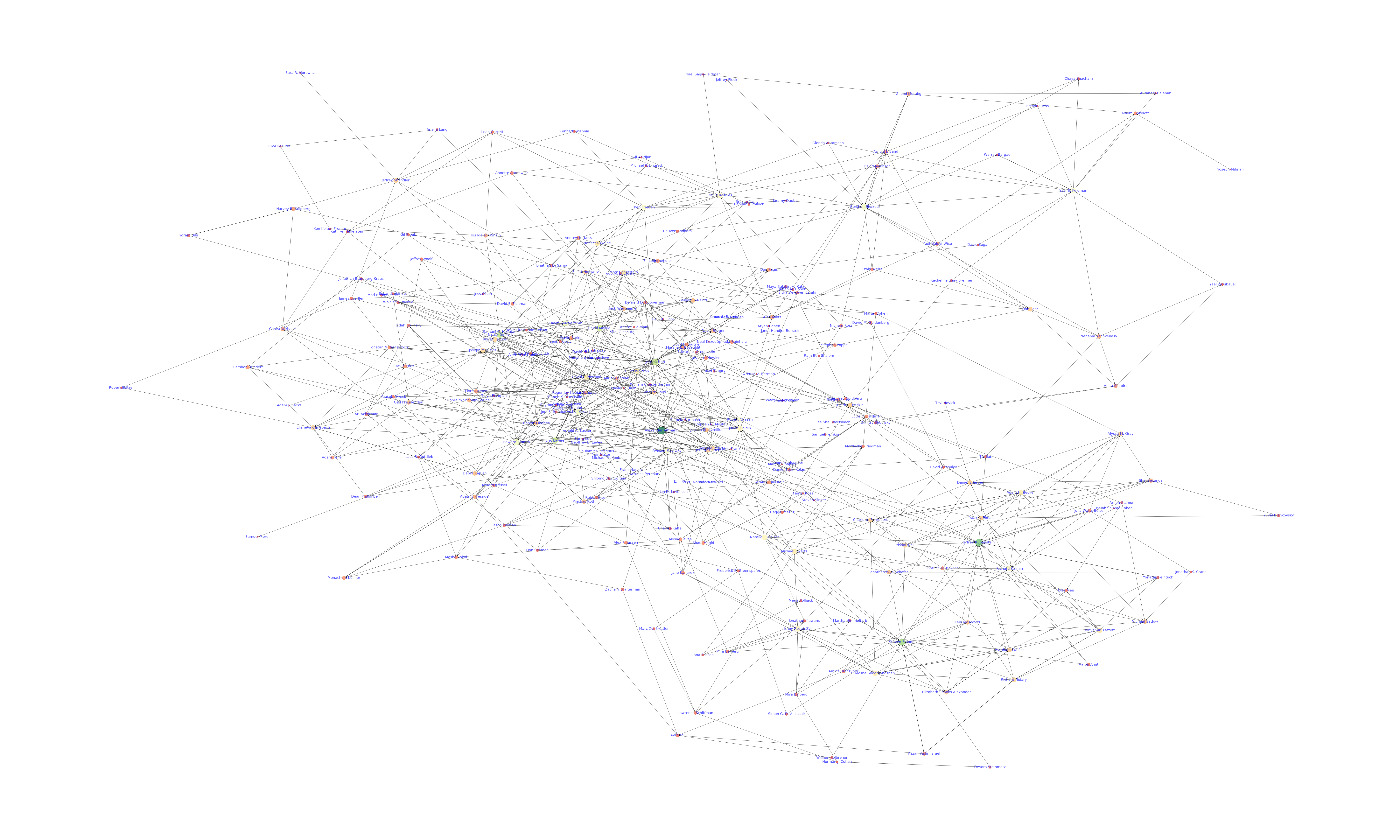
The following visualizations illustrate the citation network of AJS Review, that is, who cites whom. The data is drawn from the footnotes of the research articles, as encoded in the JSTOR Data for Research metadata files. Hence, anybody who is cited but who has not authored any research articles in the AJS Review through 2014 will not be shown as citing anyone else. It is likely that this dataset is incomplete, due to the methods that we used to extract it (for more on this, see our Workflow), but it is complete enough that it should give a good idea of the network as we continue to work on it.
There are two visualizations below. The first is static, the second interactive. To make them slightly easier to access, we did not include any author whose “degree” (the total number of times an author cited or was cited by another author) was four or more. The colors and rough groupings represent the “modularity classes,” that is, an automated assessment of which authors cluster together. From a quick look, the groupings seem more or less plausible, e.g., those authors who write on rabbinics are grouped largely together. But, as always, we are interested in what you think – you can add your comments here or on our Participate! page.
Static Image
The image is large and cluttered, but you can zoom in or download it to get a better view.
Dynamic Image
You can click on any of the nodes to highlight the authors connected to them. You can zoom in and use your right mouse button to pan. You can also search for particular authors in the panel on the left.
